Risk Assessment
The robot integrator must perform a risk assessment of the complete robot application. SD35/70 is only a component in a robot application. Safe use of SD35/70 relies on the integrators ability to design a safe robot application. SD35/70 is designed with features especially suitable for collaborative applications:
Smooth and rounded design without any sharp edges or pinch points.
Linear compliance and build in certified safety sensor.
Safety shield shielding the rotating bit and pointy screws thereby protecting humans from sharp, rotating elements.
Light and sound signals making tool operations more predictable.
Spin Robotics have identified the potential hazards listed below as significant hazards that must be addressed by the integrator:
Injuries due to collisions between humans and robot, tool, or other obstacles.
Minimizing the risk that human limbs can be placed at the screw action positions.
The robot installation is placed too close to large obstacles e.g., walls and other machines resulting in humans is wedged in between the robot and the obstacle.
Consequences if SD35/70 cable get stuck to equipment/personal.
Consequences due to lose bolts not tightened correctly.
Before start using the SD35/70 screwdriver tool in a collaborative application together with a robot, please ensure the following:
Ensure that the SpinMount tool flange is fastened sufficient, the supplied M6 screws are used, and that the small Ø6 dowel pen is used together with the four M6 screws
Ensure that no electrical wires are modified
Robot speed is set to maximum 250 mm/s when approaching the screw location.
Ensure that the front LED of the SD35/70 is enabled. (Flashing yellow when the robot is moving).
Ensure that screw driving is started no higher that than 6 mm above the object to avoid danger of crushing body parts between the SD35/70 tool and object. See description in 3.4.1
The safety shield is not removed and is functioning.
Ensure that screws longer than 35 mm are not used in collaborative applications where no additional safety system is utilized. See description in 3.4.1.
Ensure that the programmed robot paths are not moving the tool in a height where the tool can be near a human head
Ensure that the screwdriver approaches the screw insertion position perpendicularly (90 degrees), in the trajectory of the z-axis to avoid contact with sharp edges of the safety shield. See description in section 3.4.3.
Ensure that the included cable binders are used to fasten the power and signal cable to the robot arm to avoid human arms and head to be entangled between the robot and cables
Ensure that the Safety cable is correctly installed between the SpinBridge, and the robot controllers Emergency stop input terminals.
Before start using the SD35/70 screwdriver tool in a collaborative application together with a robot, the robot integrator could consider the following:
Setting up safety zones in the robot software that reduces dangerous robot trajectories by setting safety planes. Please see the robot manual for further instructions.
Add extra safety sensors in fixtures and other equipment to avoid the robot to run without a product is ready in the fixture. This avoids human limbs getting crushed due to missing parts.
If dangerous robot trajectories cannot be avoided ensure that the user of the robot uses other safety measures like eye protection and/or helmet and that humans are protected to get close to the robot during the dangerous robot movements.
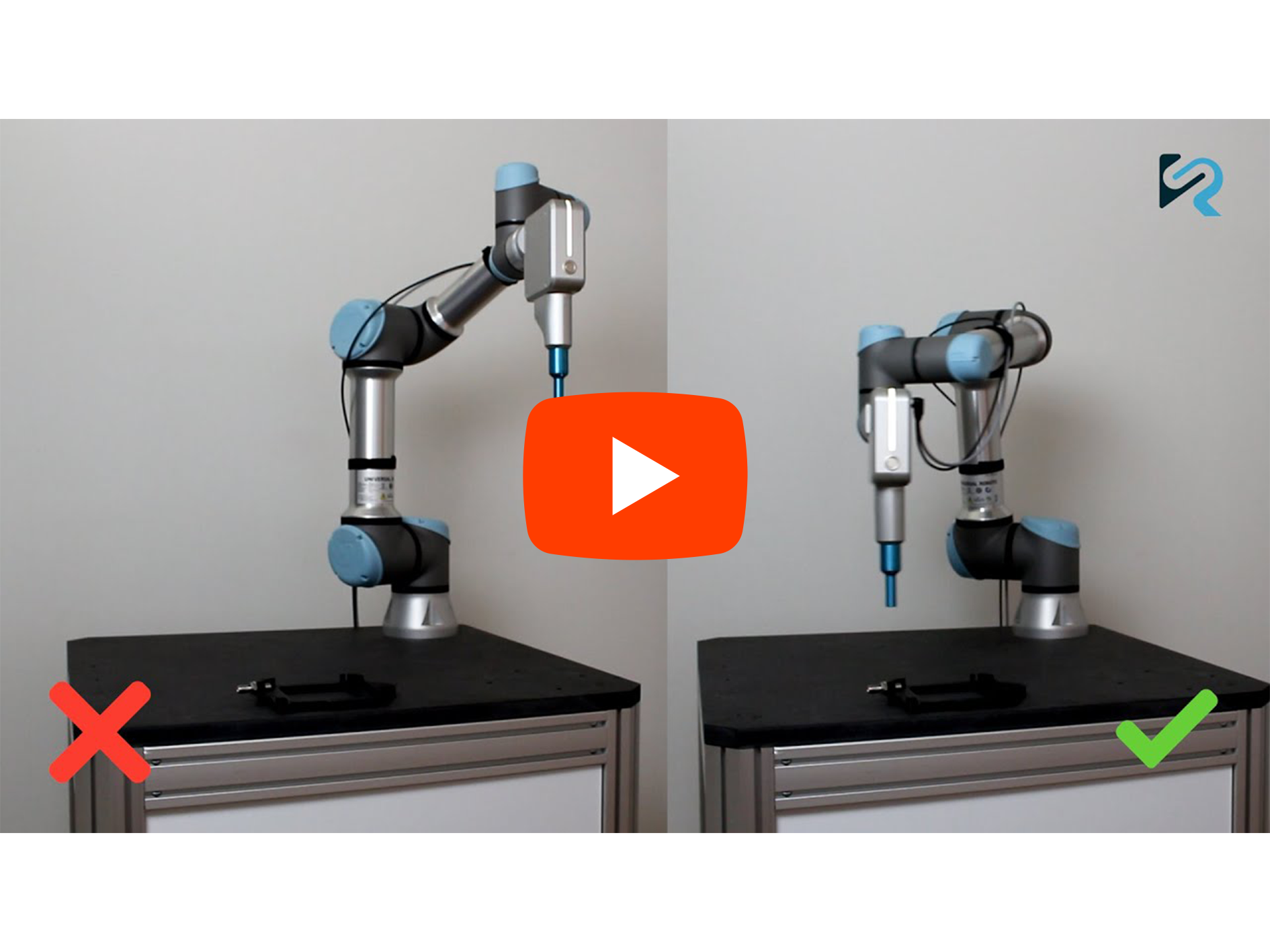
Video tutorials with recommendations for installing a collaborative safe installation are found at our website and on the Spin Robotics YouTube channel at https://www.youtube.com/
The SD35/70 tool has been tested in accordance with the ISO/TS15066 technical specification to ensure that the defined force impact limited in ISO/TS15066 is not exceeded. Based on these measurements it is recommended that the robot speed is not exceeding 250 mm/s when the tool approaching the screw insertion position to avoid exceeding the maximum allowed forces defined in ISO/TS15066. All technical reports from the impact force test can be found at https://spin-robotics.com/